
Route and Beat Planning for Distributors in Saudi Arabia
How Saudi FMCG distributors plan routes and beats: split territories, rank outlets A/B/C, set visit frequency, size a rep's day, and track 4 key numbers.
By Morovix Team
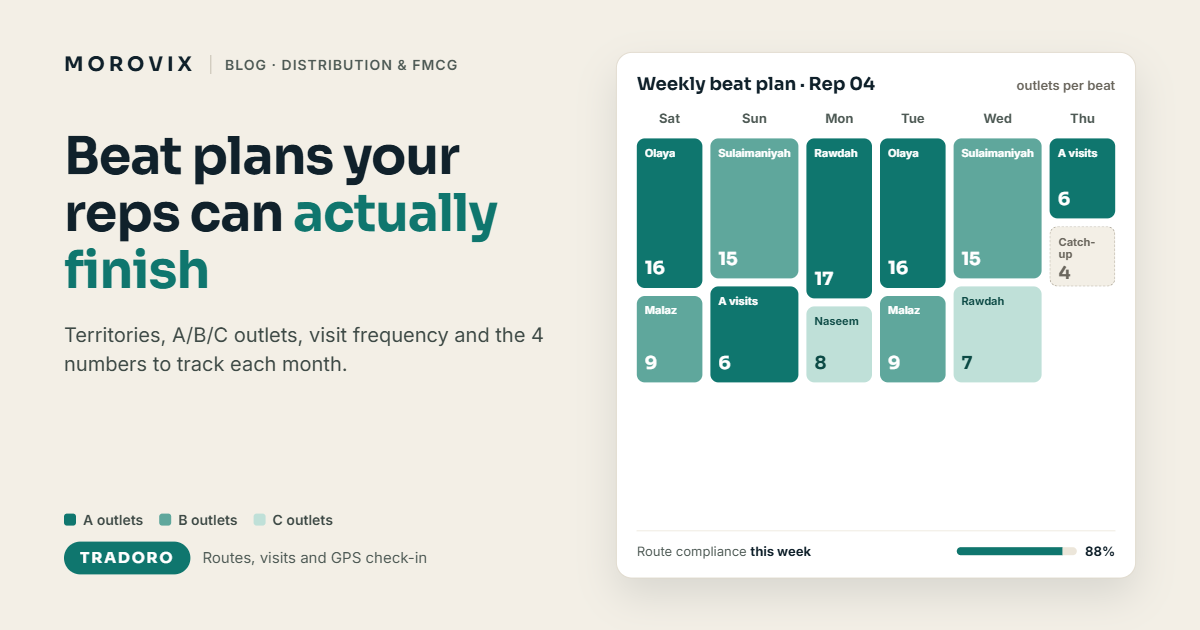
A good beat plan tells each rep which outlets to visit, on which day, in what order and how often, so that your best customers are never missed and no rep spends half the day driving. To build one, split your area into territories, rank outlets by value, set a visit frequency for each rank, and size each day so a rep can actually finish it.
TRADORO, Morovix's distribution platform, runs routes and beats with visit sequence, frequency, A/B/C priority and GPS check-in. This guide covers how to design the plan itself, which works whatever system you use.
Route vs beat: what's the difference?
People use the words loosely, so here's how we use them in this guide:
- A beat is a fixed group of outlets a rep covers in one day, such as "Al Olaya Tuesday".
- A route is the order the rep visits those outlets in, and the path between them.
- The beat plan is the weekly or monthly calendar that says which beat each rep covers on which day.
Get the beats right first. A perfect route through the wrong outlets doesn't help.
Step 1: Split your area into territories
Start with a map of every active outlet. Group them into territories that one rep can own, using natural boundaries such as main roads, districts and industrial areas rather than straight lines on a map. Crossing a busy road several times a day is one of the biggest hidden time costs in Saudi cities.
Each territory should have roughly similar sales potential, not just a similar number of shops. Ten large supermarkets can be more work than forty small groceries.
Step 2: Rank outlets A, B and C
Not every outlet deserves the same attention. A simple ranking:
| Rank | Typical outlet | What it means for visits |
|---|---|---|
| A | High sales, key accounts, modern trade | Never missed; visited most often |
| B | Steady mid-size outlets | Regular visits on a fixed day |
| C | Small or occasional buyers | Less frequent visits, or combined with nearby A and B outlets |
Rank by actual sales over the last three to six months, then adjust for growth potential and payment behaviour. Review the ranking every quarter.
Step 3: Set visit frequency
Frequency should follow how fast the outlet sells through your products, not habit. As an example of how many distributors set it up:
- A outlets: once or twice a week
- B outlets: once a week
- C outlets: every two weeks
Check this against stock-outs. If an A outlet regularly runs out of your fast movers between visits, increase the frequency. If a C outlet orders the same small amount every visit, try visiting less often.
Step 4: Size a rep's day
The most common planning mistake is putting more outlets in a beat than a rep can visit. Work it out instead of guessing:
Visits per day = selling hours ÷ (average time per visit + average travel between outlets)
For example, with 7 selling hours, 15 minutes per visit and 10 minutes of travel, a rep can realistically make about 16 visits. Plan for slightly less than the maximum, so a slow visit or traffic doesn't push the last outlets into tomorrow.
Saudi-specific factors to build in:
- Prayer times: many outlets slow down or close briefly, so avoid planning key visits right before or during them.
- Summer afternoons: heat affects both drivers and stock, so many distributors front-load the day.
- Ramadan: opening hours shift to later in the day and evening, so beats usually need a separate Ramadan plan.
- Weekends: plan Friday and Saturday coverage around when your outlets actually trade.
Step 5: Sequence the route
Within each beat, order the visits to keep driving short and to reach important outlets early:
- Start with the outlet nearest the warehouse or the rep's start point, or with the A outlet that orders earliest.
- Move through one area at a time instead of zig-zagging.
- Avoid U-turns across main roads where possible.
- Put C outlets where they fit along the way rather than as separate trips.
Step 6: Track four numbers
A beat plan is only as good as its execution. Review these monthly by rep and by beat:
| Measure | How to calculate | What it tells you |
|---|---|---|
| Route compliance | Outlets visited ÷ outlets planned | If reps follow the plan |
| Strike rate | Visits with an order ÷ total visits | If visits turn into sales |
| Average drop size | Sales value ÷ number of orders | If you're getting enough per visit |
| Missed A outlets | A outlets not visited when planned | Where you're putting key accounts at risk |
Low compliance usually means the beat is too big. A low strike rate may mean the frequency is too high or the outlet mix is wrong.
How TRADORO handles routes and beats
- Routes and beats set by territory and rep, with visit sequence and daily, weekly or custom frequency.
- A/B/C outlet priority on the customer and outlet master, along with channel, region, territory and GPS location.
- Today's Route on the rep's phone, with Google Maps links to each outlet.
- GPS check-in and check-out with time, and each visit marked completed, missed or rescheduled.
- Visit notes and tasks with reminders.
- Reports on route execution, sales by route and salesman, and task productivity.
Routes are where van sales happen, so see our van sales app guide for what happens at each visit, and our FMCG distribution software guide for the full system.
Frequently asked questions
What is beat planning in FMCG? Beat planning is deciding which group of outlets each sales rep visits on each day, and how often each outlet is visited, so that coverage is consistent and predictable.
How many outlets should a rep visit per day? It depends on visit time and travel time. Divide selling hours by the average time per visit plus travel. For example, 7 hours with 25 minutes per visit including travel gives about 16 visits.
How often should I visit each outlet? Base it on how fast the outlet sells your products. Many distributors visit A outlets once or twice a week, B outlets weekly and C outlets every two weeks, then adjust based on stock-outs.
What is route compliance? The share of planned outlet visits that actually happened. GPS check-in makes it measurable instead of relying on reps' reports.
Can TRADORO track whether reps followed the route? Yes. Reps check in and out with GPS and time, visits are marked completed, missed or rescheduled, and route execution reports show the results by rep and route.
See your own beat plan in TRADORO
Send us your outlet list and we'll set up one rep's weekly beat plan in TRADORO. Request a demo or message us on WhatsApp at +966 50 433 4135.
Ready to Transform Your Business?
Discover how AI, automation, and smart software solutions can improve your business operations.
Request a Free Initial Consultation